Car Accident Claims
What To Do Immediately After a Car Accident — A Step-by-Step Guide for US Drivers
From the moment of impact to the call with your insurer, here is exactly what to do after a car accident in the US — a step-by-step guide that protects your health, your wallet, and your claim.
By Maya Doroshenko · May 14, 2026 · 11 min read

The minutes right after a car accident are the most important — and the most disorienting — of the entire claims process. What you do (and what you say) at the scene shapes how your insurer values your claim, how the police describe fault, and how protected you are if the other driver later changes their story. This step-by-step guide walks US drivers through exactly what to do after a car accident, in the order it should happen, with the practical reasoning behind each move.
Save this car accident guide to your phone now. The whole point of an after car crash checklist is that you do not have to think under stress — you just follow the steps.
Key takeaways
- Stop immediately, check for injuries, and call 911 for anything beyond minor cosmetic damage.
- Move to safety if possible, but never leave the scene before exchanging information.
- Always request a police report — it is the single most powerful document in any claim.
- Photograph everything: vehicles, plates, road, signage, weather, and the other driver's documents.
- Exchange only the basics. Do not apologize, admit fault, or speculate about injuries.
- Notify your insurer the same day, and see a doctor within 72 hours even if you "feel fine."
Step 1: Stop the vehicle and breathe
Even a low-speed collision triggers an adrenaline spike that narrows your focus and slows decision-making. Before you reach for the door handle, take three deliberate breaths. This single pause is the difference between a clear-headed accident scene and one where you forget to take photos, leave evidence in the road, or say something an adjuster can use against you later.
Leaving the scene of any crash — even a minor one — is a criminal offense in every US state. The legal duty to stop applies whether or not you believe you were at fault, and whether or not the other driver is present (in a parked-car scenario you must leave a written note with your contact information).
Step 2: Check yourself, your passengers, and the other driver
Run a quick body scan: any pain in your neck, back, head, or chest? Then check your passengers, then the occupants of the other vehicle. If anyone reports pain, dizziness, numbness, or visible injury, call 911 immediately. Do not move an injured person unless they are in active danger from fire or oncoming traffic — improper movement can worsen spinal injuries.
Calling paramedics also creates a contemporaneous medical record. That record is enormously valuable later if a soft-tissue injury surfaces 24–72 hours after the crash, which is extremely common with whiplash and concussion.
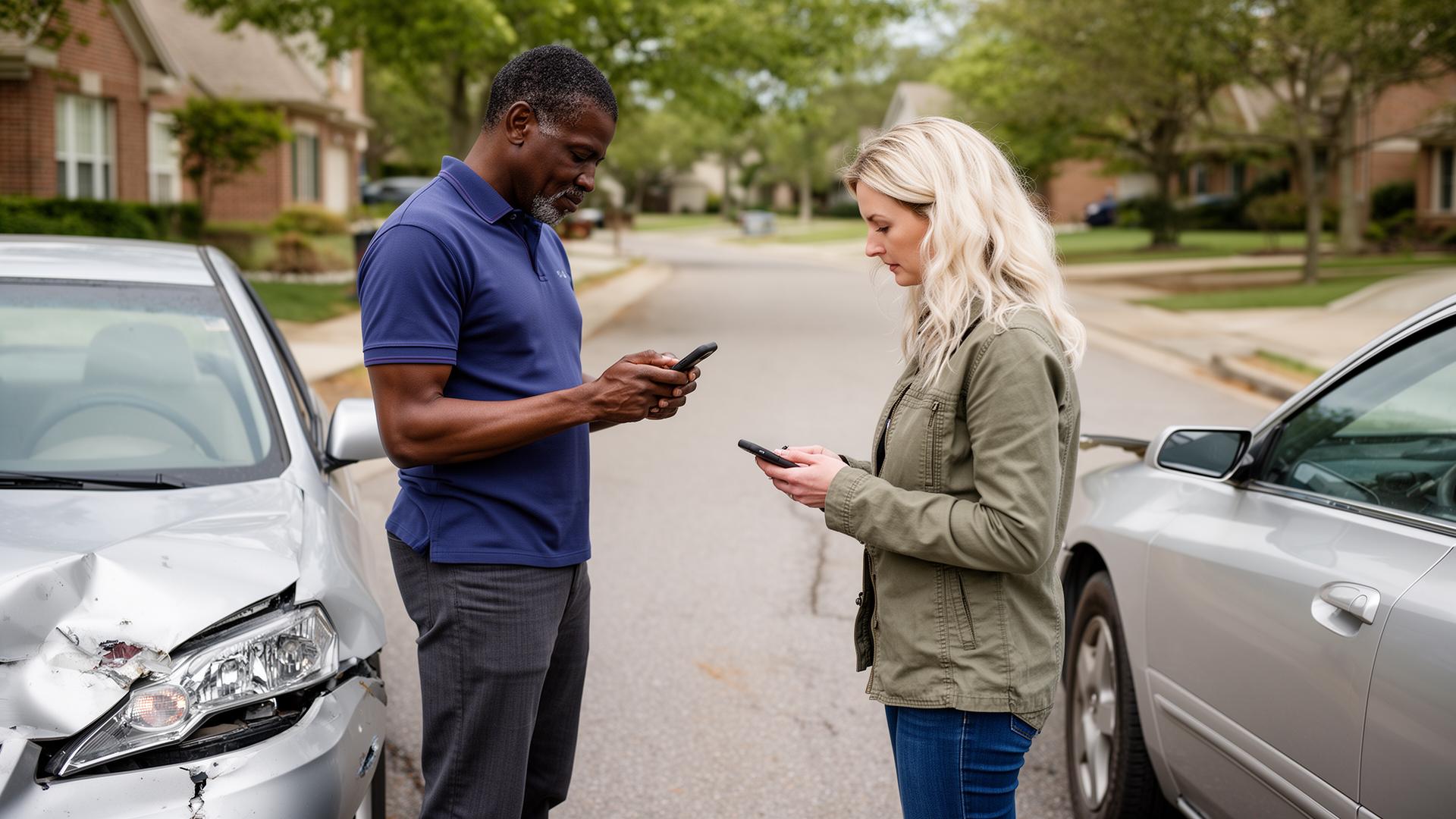
Step 3: Move to safety (if it is safe to do so)
If your vehicle is drivable and the crash is minor, move it to the shoulder, a parking lot, or any location clear of moving traffic. Turn on your hazard lights. If you carry road flares or reflective triangles, set them up roughly 100 feet behind your vehicle. On highways, secondary collisions caused by stationary cars in live lanes are one of the most common ways minor crashes turn fatal.
If the vehicle is not drivable, leave it where it is, get yourself and your passengers to a safe spot off the roadway, and wait for police.
Step 4: Call the police — every time
This is one of the most under-rated accident scene tips. Even when the other driver pleads with you not to involve police, call them. A neutral, time-stamped police report carries more weight with insurance adjusters than any other piece of evidence you can produce.
In most US states, an officer is required to respond to crashes that involve injury, a fatality, or visible property damage above a state-set dollar threshold (often $500–$2,500). Even when an officer says a report is "not necessary," politely insist — and at minimum get the responding officer's name, badge number, and the report number you can use to request a copy later.
If law enforcement refuses to come to a minor crash (some jurisdictions skip non-injury fender benders), file a self-report at the nearest station within 24 hours. Almost every state DMV accepts driver-filed crash reports for low-severity collisions.
Step 5: Document the scene like a journalist
Treat your phone as the most important tool you have. The goal is to capture more evidence than you think you will ever need, because you cannot go back later. Photograph:
- Wide context shots of the entire intersection or roadway, including traffic signals, signage, and road markings.
- All four sides of both vehicles — not just the damage, but the undamaged sides too (this proves pre-existing condition).
- Close-ups of damage, license plates, and VINs.
- Skid marks, fluid trails, broken glass, and debris in the position you found them.
- Road conditions: potholes, ice, wet pavement, sun glare, obstructed sightlines.
- The other driver's documents: insurance card (front and back), driver's license, and registration.
Take a 30-second video panning across the scene with audio. Your phone embeds GPS coordinates and a timestamp into every photo's metadata — that data is admissible evidence and effectively impossible to fake.
What to write down (or dictate to your phone)
- Date, time, and exact location (cross streets, mile marker, or GPS pin).
- Direction each vehicle was traveling and approximate speed.
- Weather, lighting, and visibility.
- Names and phone numbers of every witness.
- Responding officer's name, badge, and report number.
- Your own narrative of what happened, in your own words, before memory drifts.
Step 6: Exchange information — but only the basics
You are legally required to exchange a specific, limited set of information with the other driver. You are not required to discuss fault, theories of what happened, or how you are feeling physically. Stick to:
- Full name and address
- Phone number
- Driver's license number and state
- License plate number
- Insurance company name and policy number
- Vehicle make, model, year, and color
Do not say "I'm sorry," "I didn't see you," or "I think I might be at fault." A reflexive apology is a cultural courtesy in many parts of the US, but in claims work it can be quoted as an admission and shave thousands off your settlement. The same goes for injuries — never say "I'm fine" before you have been examined by a doctor.
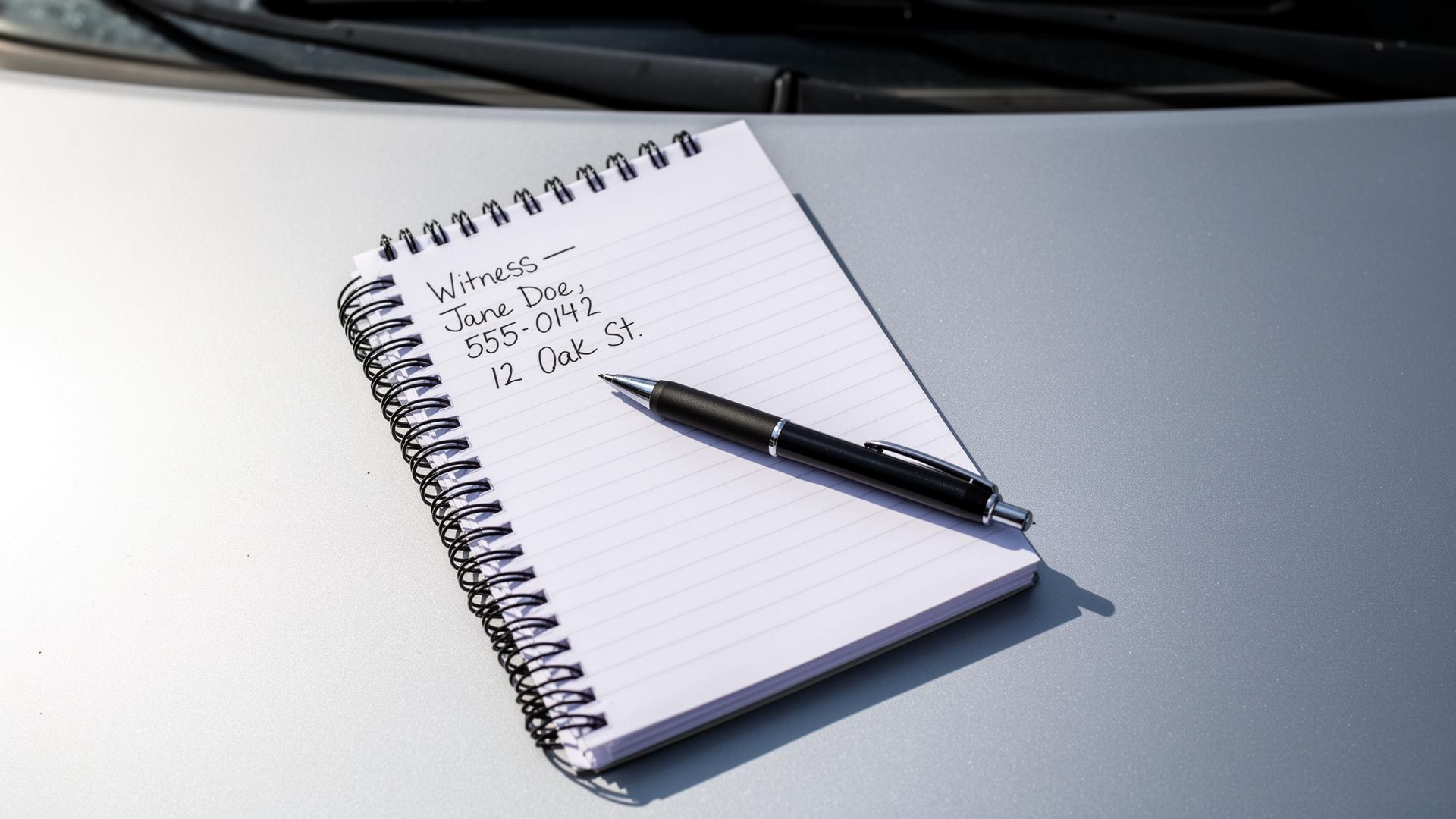
Step 7: Talk to witnesses before they disappear
If anyone stopped to help, or saw the crash happen, get their name and phone number before they leave. A neutral third-party account is often the deciding factor when two drivers tell opposite stories. Ask if they would be willing to give a brief written statement or short voice memo describing what they saw — most people will say yes if you ask politely while the moment is fresh.
Step 8: Notify your insurer the same day
Almost every auto policy in the US includes a "prompt notice" clause. Wait too long, and the carrier can reduce or deny your claim purely on procedural grounds — even if the underlying loss is fully covered. The safest practice is to call or open a claim in the app the same day, even if you are not yet sure whether you want to pursue it.
When you call, stick to the facts you can verify: where, when, who was involved, and what was visibly damaged. Do not speculate about fault, do not estimate dollar amounts, and do not agree to a recorded statement about injuries until you have seen a doctor. For a deeper walkthrough of what to expect from your carrier next, read our companion guide on how to file a car insurance claim.
Step 9: Get medical attention within 72 hours
Adrenaline is a powerful painkiller. It is extremely common to leave the scene of a crash feeling "fine" and to wake up the next morning with searing neck pain, a persistent headache, or numbness down one arm. The longer you wait to see a doctor, the easier it becomes for an adjuster to argue your symptoms are unrelated to the crash.
Even if you suspect nothing is wrong, schedule a same-week visit with your primary care doctor or an urgent care clinic. Describe the crash, the impact direction, and any symptoms — however small. The medical record that results is what links any future treatment to this specific accident.
Step 10: Preserve evidence and avoid repair shortcuts
Do not repair, wash, or vacuum your vehicle until your insurer (and, if relevant, the other driver's insurer) has had a chance to inspect it. Keep all damaged parts, even small ones — broken trim pieces, shattered glass, and the dashcam SD card belong in a labeled bag in your trunk, not in the trash.
Save every receipt: tow truck, rental car, prescription co-pays, mileage to and from medical appointments. These line items are reimbursable in most claims, but only if you can document them.

What NOT to do after a car accident
Do not admit fault
Fault is a legal determination that involves traffic laws, witness statements, vehicle data, and sometimes accident reconstruction. You are not qualified to make it on the side of the road, and neither is the other driver. Let the adjusters and police sort it out.
Do not sign anything from the other driver's insurer
If the other driver's insurance company calls you within hours of the crash, that is by design. Anything they ask you to sign — a release, a medical authorization, or a "statement of facts" — is written to protect their bottom line, not yours. Politely decline until you have spoken with your own carrier and, if injuries are involved, a personal injury attorney.
Do not post about the crash on social media
Photos, status updates, and even check-ins can and will be used by adjusters. A smiling selfie posted three days after a crash you are claiming back pain from is a settlement-killer.
Do not skip the police report because it is "minor"
"Minor" damage routinely turns into a $4,000 repair once the bumper cover comes off and the impact bar is bent. Without a police report, you are negotiating from memory against an adjuster with a database.
Special situations
Hit and run
If the other driver flees, do not chase them. Note the make, model, color, plate (or partial plate), and direction of travel. Call 911. File a police report within 24 hours. Then notify your insurer — uninsured motorist coverage typically applies in hit-and-run claims, but only if you reported the incident promptly.
Single-vehicle crashes
You still need to call the police, document the scene, and notify your insurer the same day. Collision coverage applies regardless of fault, but late reporting is the most common reason single-vehicle claims get reduced.
Crashes involving rideshare or commercial vehicles
Get the driver's name, the company they were driving for, the vehicle number, and a screenshot of the rideshare receipt if you were a passenger. Commercial policies have higher limits but stricter notice requirements.
Crashes in another state
The laws of the state where the crash occurred generally govern fault, statutes of limitations, and minimum required coverages. If you crash out of state, request the local police report and ask your insurer which state's rules will apply.
Authoritative resources for US drivers
If you want to dig deeper into the official guidance behind the steps above, three independent sources are worth bookmarking. The National Highway Traffic Safety Administration (NHTSA) publishes the federal guidance on what to do at a crash scene. The Insurance Information Institute maintains plain-English explainers on every major US auto coverage. State-by-state reporting requirements are summarized at USA.gov motor vehicle services.
Your first 24 hours: a recap
- Stop, breathe, check for injuries, call 911 if anyone is hurt.
- Move to safety, hazards on, flares out if available.
- Call the police and request an on-scene report.
- Photograph and video everything before vehicles are moved.
- Exchange only the legally required basics — no fault talk, no apologies.
- Collect witness contact details on the spot.
- Notify your own insurer the same day.
- See a doctor within 72 hours, even if you feel fine.
- Preserve the vehicle and every receipt until inspections are complete.
- Decline recorded statements and signed releases from the other driver's insurer until you have advice.
Final word: act calm, document hard, talk less
Almost every car accident settlement is won or lost in the first 24 hours — long before any adjuster opens a file. The drivers who walk away with full payouts are not the ones who argue loudest at the scene. They are the ones who stayed quiet, photographed everything, called the police, called their insurer, and called a doctor. Follow this car accident guide in order and you will be one of them.
Once you have completed the steps above, the next phase is the claim itself. Read our companion walkthrough — How to File a Car Insurance Claim: Everything You Need to Know — to keep the momentum and protect your settlement from day two onward.
Frequently asked questions
What is the very first thing to do after a car accident?+
Stop your vehicle, take a deep breath, and check for injuries — yourself, your passengers, and the other driver. If anyone is hurt, call 911 before you do anything else. Never leave the scene of a crash, even if you believe it was not your fault.
Do I have to call the police for a minor car accident?+
In most US states, yes — any crash involving injury or visible damage above a state-set dollar threshold legally requires a police report. Even when not strictly required, calling the police creates a neutral, time-stamped record that strongly protects your insurance claim.
Should I admit fault at the accident scene?+
No. Fault is a legal determination based on traffic laws, witness statements, and physical evidence — not a curbside conversation. A casual apology can be quoted later as an admission. Stick to exchanging factual information and let the insurers and police handle fault.
How long after a car accident do I have to file an insurance claim?+
Most US auto policies require prompt notice — typically within 24 to 72 hours. Statutes of limitations for lawsuits range from one to six years depending on the state. In practice, you should notify your insurer the same day and see a doctor within 72 hours to preserve all your rights.
Continue reading
Sources
Have you ever filed a car insurance claim?
Share your experience or send us a tip — our reporters read every email and use anonymized stories to shape future coverage.
Send us your storyMore from Crash & Cover

How to Negotiate an Insurance Settlement After a Car Accident — Step by Step Guide
The insurance company's first offer is almost never their best offer. Here is the step-by-step playbook for countering lowball offers and negotiating the settlement you actually deserve.
Daniel Reyes · May 21, 2026 · 16 min

Car Accident Settlement — How Much Money Can You Get?
Car accident settlements range from a few thousand dollars to millions. Here's exactly how payouts are calculated — and how to make sure you get every dollar you deserve.
Daniel Reyes · May 15, 2026 · 13 min

What to Say (and NOT Say) to Your Insurance Adjuster After a Crash
Insurance adjusters are trained to settle for as little as possible. Here's the exact script — what to say, and what to never say — when an adjuster calls after your crash.
Daniel Reyes · May 15, 2026 · 11 min